Posted on Leave a comment

How are Log Cabins constructed?

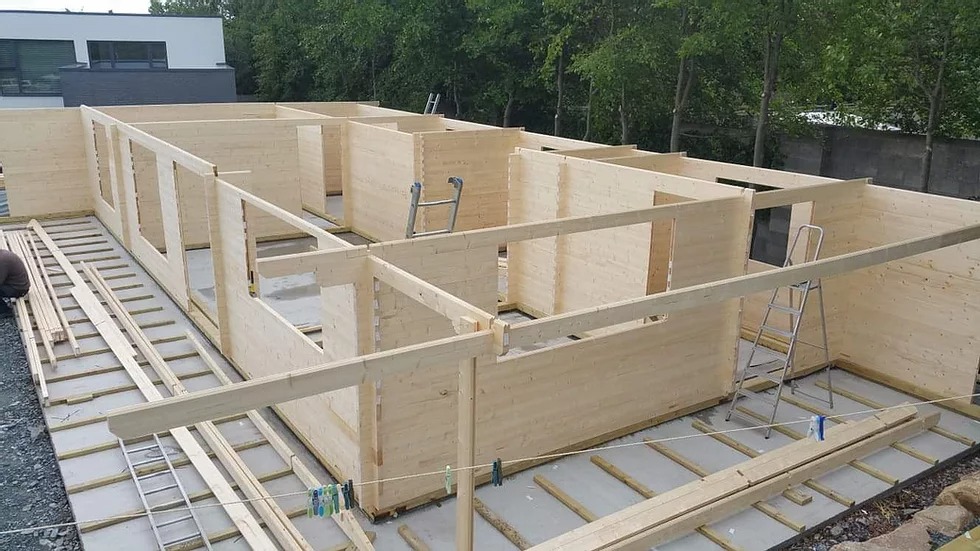
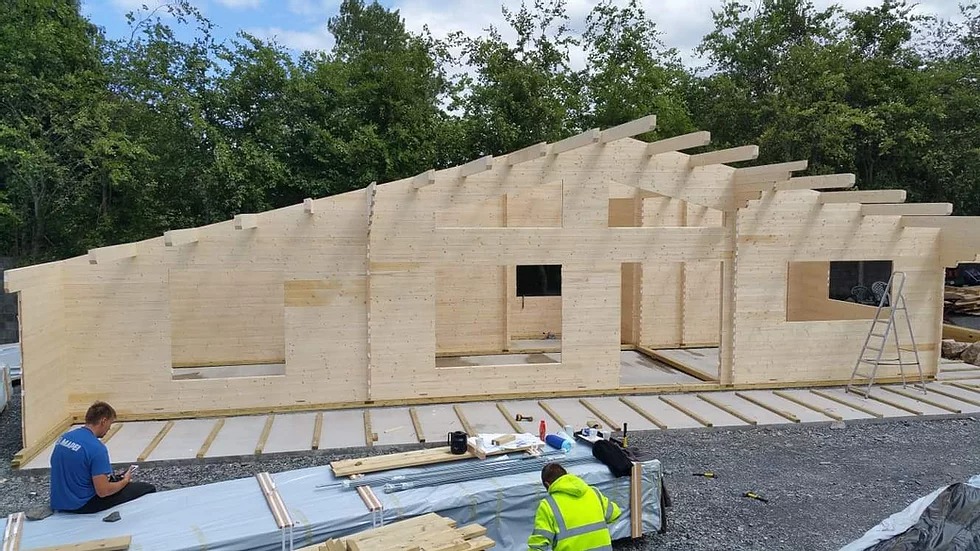
Building a log cabin

The timber in your log cabin is most important element of your new home, but it is worth nothing if your cabin is not built by experienced log cabin builders.
8d8ae4 8698269c04b14071af1b6e457

Of course, while the materials used in your log cabin are of paramount importance, we must not forget that the method of construction and the intrinsic design of the building envelope are also key features that make timber living log cabins Ireland the best quality and value log cabins available in the country.

The Best Log Cabin Timber

We use only the highest grade Norway Spruce timber in our log cabin homes. This timber is sourced in Siberia, where the trees are 150 years old when they are harvested. They are extremely well suited to timber for construction  of log houses Ireland. Because they have a very short growing season, these trees have extremely tight grain, and and will not twist, warp or buckle overtime. Have a read of our blog post all about log cabin timber here: ,,What timber should a log cabin be built with?
Building a log cabin

The double-glazed, tilt-and-turn windows and five-point locking doors in our log houses are made of extremely high quality, and will endure for a lifetime. We also offer a wide choice of different log cabin windows, including white or coloured PVC windows. Read our blog post here: ,,Which windows for your log cabin?

Log cabin insulation

We use high quality Kingspan log cabin Insulation in our log cabin homes. Our log cabin in Boyle was built for us in the spring of 2018. The summer of 2018 was a great summer – really hot for weeks! (Will we ever forget!) Anyway, we were really amazed at how cool the cabin remained all of that summer, despite the sun beating down on our black roof. The coolness was due to the quality of insulation in our log cabin roof. (And also due to the positioning of our cabin – we get very little sun in through our windows. Come and visit us at the Boyle Log Cabin Showhouse and you’ll see…)

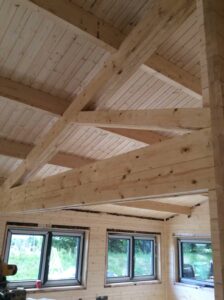
Our  standard log cabin  insulation thickness is 100mm, but this can be increased according to the customers wishes or planning specifications.
22

Log Cabin Roofing

We use a quality pressed Steel tile effect roofing panel which is sturdy and enduring. These panels are quick to fit and storm proof. we have a cabin on the Aran Islands for the last number of years, and it is still there! – a very high performing roof on that log cabin.

Our roofs are fitted with a minimum of 100 millimetres (four inches) of Kingspan PIR insulation, which, combined with our 19mm ceiling boards provide a great level of insulation.

Common Mistakes of Log Cabin Construction

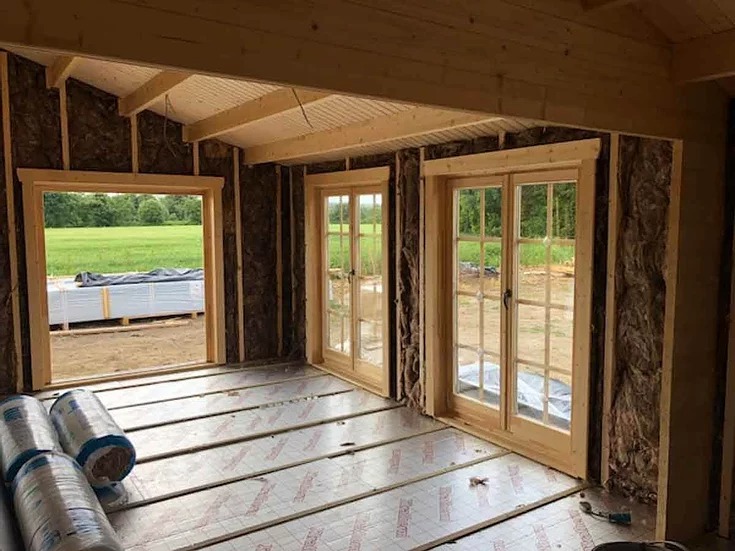
It is a common mistake of many log cabin installers to use rockwool insulation under floors. This is a drastic mistake.  In wintertime, at temperatures below 4 degrees, condensation forms on the concrete slab and rockwool insulation soaks this condensation up. Your installation is not insulation when it is wet. You have a cold floor or and damp problems. You must have Kingspan Insulation in your log cabin floor.

Another drastic mistake is to opt for single wall construction, especially if your cabin is being heated during cold winter nights. A cavity construction is vital in these conditions to avoid condensation, damp and mould on interior walls. A single wall, even a 90 millimetre wall, is insufficient insulation for a residential cabin, and will need to be dry-lined. The surface of a single wall cabin will form mould on cold nights in unseen places, such as behind wardrobes. This is because these areas are not heated – the wardrbe does not let the heat in behind. So the wall surface is still cold, and the damp air in the cabin condenses on the cold surface, and lo and behold – mould! Not what you want in your cabin. That’s why you buy from a company sch as Timber Living Log cabins, who have been building cabins for over twnty years, and have seen every conceivable problem in Log Cabin construction, and solved them all.


 Installing a stove in your log cabin

There are no restrictions on the heating system that can be installed in a log house. Stoves with or without back boilers are straightforward installations. Of course, oil and gas central heating systems are also an option as our underfloor heating and inverters. Just contact us at TimberLiving and we can fill you in on all of the technical details required.

How long does it take to build a log cabin?

We always tell customers that, at a push, you could move into your log cabin four weeks after breaking ground. Now, that’s at quite a push, and also depends on the size of the cabin. But the speed of construction is one of the great benefits of buying a log cabin.

Lets look at ow the timeline could pan out for one of our Limerick Log cabins.

Week 1: Pour the base.

Week 2: Monday/Tuesday. Build the exterior of the cabin. Wednesday first fit electrics. Thursday First fit plumbing.

Week 3: Monday-Wednesday complete the cabin construction. Thursday/Friday floor coverings

Week 4: Monday Complete electrical. Tuesday/Wednesday complete plumbing and install heating. Thursday Friday install kitchen.

Okay, its a bit of a push, but it does illustrate how quickly your cabin can be built. We always say, if you order today, you COULD be in in three months, if you line up your ducks properly…

Come visit us in our show houses, or give us a call to organise an appointment.

Call Tullow 05991 81039

Call Boyle 0868170429

CAll Carrigaline 087 6464 280

We look forward to hearing from you!

#insulationforlogcabins #logcabininsulation #logcabins #logcabinsforresidentialuse, #residentiallogcabins #weatherproofingtimberbuildings
Posted on Leave a comment

Which windows for your log cabin?

Log Cabin Windows

Choice is key when it comes to log cabin windows, because everyone’s taste is different

Windows are a very important element of your log cabin. They let the light in: they’re an architectural feature: they should also keep as much heat inside the cabin as possible. So, which windows do you choose when buying your cabin from Timber Living Log Cabins Ireland?

Full height PVC windows for your log cabin

We have the best log cabin windows

“The eyes are the windows to the soul”. Sounds like a completely irrelevant way to start this article, but bear with me! Of course, you’re going to need windows in your log cabin, but the windows do a lot more than just let the light in. Depending on your window size, they might not let enough light in. Then again, they might let too much heat out! Window choice is important!

Get the right windows for your log cabin

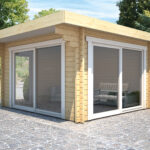
As you can see from the picture gallery above, we have a host of different window sizes and shapes, all of which are available to you.

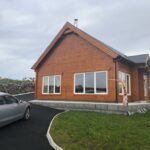
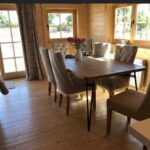
Take a look at our Sligo log cabin as a great example of how you can light up your cabin interior with the right window choice.

And our Cavan Log cabin is another interesting choice. This cabin would be ideal as a holiday home, if your location has the stunning views.

Window Size and Shape

There is no restriction on the window size and shapes we can produce. Just ask any of our representatives, in Tullow, Boyle or Carrigaline, and we’ll be glad to talk you through all of the options.

Log cabin Window choices

Make sure you get the right shape of window for your log cabin. What factors should you consider?

  • South facing? There’s no doubt but that you should, if at all possible, have your main window wall facing south, or at least between south east and south west. You’re going to get the best light of the day, and also benefit much more from solar gain.
  • Balance Solar Gain with Heat Loss. If you’ve got a beautiful view, you’re going to want big windows to take in the view. There’s lots to consider here. Big windows are great, but they can lead to heat loss at night, so they need to be heavily curtained. And your curtains need to close off at the ends, so that the cold air behind them is trapped. Curtains that are away from the wall are ineffective, especially with large windows. The large window surface area can generate a draught, which will get the warm air in the cabin moving, and make it uncomfortable. So, by all means go for the large windows, but you’ve got to get a bit unconventional with your curtain-hanging. Want o know more about heating a log cabin?
  • Big Bedroom Windows? You don’t need a lot of light in your bedroom window, unless you’re the sort that likes to stay in bed til the sun is high in the sky. So, its probably best to keep your bedroom windows small, and, by reducing heat loss, cosy. This also means that you can put your bedrooms on the north-facing side of the building, and leave the living areas in the south-facing rooms.
  • Traditional Vs Modern Window frames. Wooden frames or pvc? Its a conundrum. Our wooden timber frames are very high wuality, amde from the best quality timber, sourced in Russia, so they are slow growing, and very strong and durable. They will last as long as you maintain them. But that is the key word – maintenance. Whie the beauty of timber cannot be fully replaced by PVC, the issue of maintenance cannot be avoided. So, if you’re going for a larger building, with lots of windows, the best advice is probably to sacrifice a bit of the traditional for th convenience of low maintenace PVC windows.
  • Double glazed, heat retaining. The major factor in double-glazed windows, besides the quality of the build – seal etc – is the gap in the window between the two panes. Always take a look at this gap – the bigger the better, the bigger the more heat is retained.
  • Cabin character. This is a difficult one to be definitive about, because it boils down to people’s tastes. Some people like a traditional looks in a log cabin, while others want something a bit more modern, more individual. But needless to say, your cabin windows really do define the character of your cabin. Usually, the choice is immediately clear to someone who is buying a cabin – as soon as they see what they like, they know it straightaway. The problems start when two people are buying, and they each want something different. But, at Timber Living, we have a wide range of log cabins, and we’re very good at finding you exactly whatyou’re looking for. Contact us now to arrange an appointment and a viewing of our log cabin showhouses.

Quality log cabin windows

At Timberliving, we realise the importance of high quality windows in your log cabin. If you come to any of our showrooms you can experience for yourself the high quality of the hardware in our windows. All of our windows are tilt and turn, double glazed timber frame windows. Notice the gap in the double glazing. This determines how well your in windows insulate you against the cold.

Timber frame or PVC windows in your log cabin?

The standard window in all of our cabins is timber. but if you are interested, we can also offer you PVC windows. PVC windows come in a wide range of colours. Of course, white is the standard colour and is a lot cheaper than a coloured PVC frame. This is because quite PVC windows are very commonplace and and the expected colour in the marketplace.

Coloured PVC Log Cabin Windows

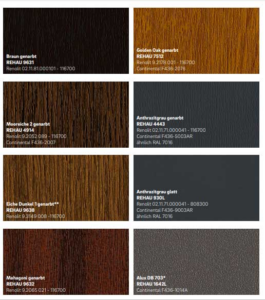
You can see REHAU’s range of PVC windows here: https://www.rehau.com/download/1893282/standarddekore-kaleido-foil.pdf

We offer a beautiful range of natural colours in coloured PVC windows from REHAU. Follow the link above to get a clear idea of the colours that are available. Coloured windows can look great in a log cabin – it all depends on personal taste. we have had come customers who have been adamant that they want the timber frame windows particularly for inside the cabin. timber windows painted white still look like timber windows, rather than PVC windows full stop and when you’re building your own log cabin, you should of course build it the way you want it. PVC has the benefit of low maintenance, but many people feel that you cannot beat the natural beauty of timber windows.

Window colour choice

Come to our log cabin show houses

Whether you’re looking for timber or UPVC windows, one, two or three bed cabins, a garden office or gym, you should come and visit us in our timber living show houses. We have show houses in Tullow, Boyle and Carrigaline. You will get all of our details on our contact page. Look forward to seeing you soon.

Posted on Leave a comment

What our log cabin show house visitors think

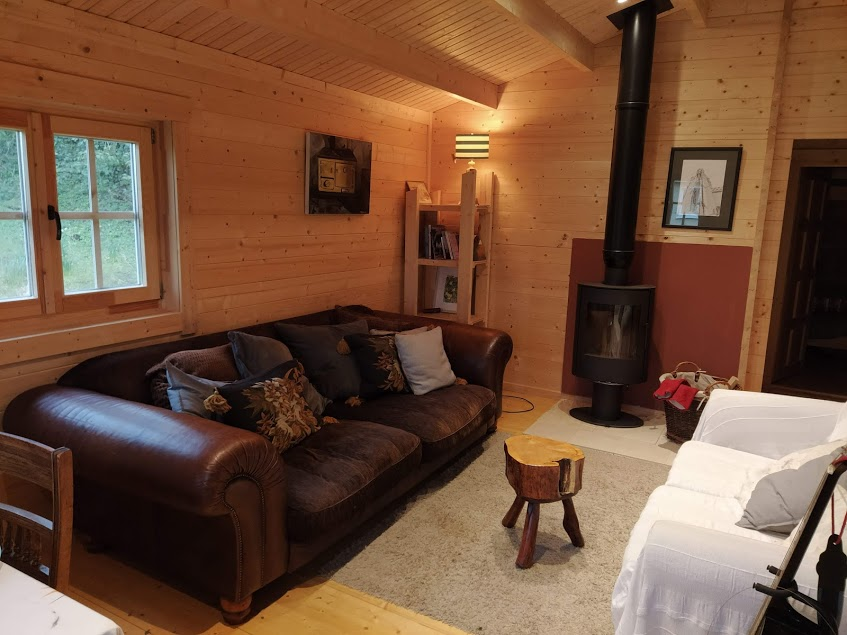
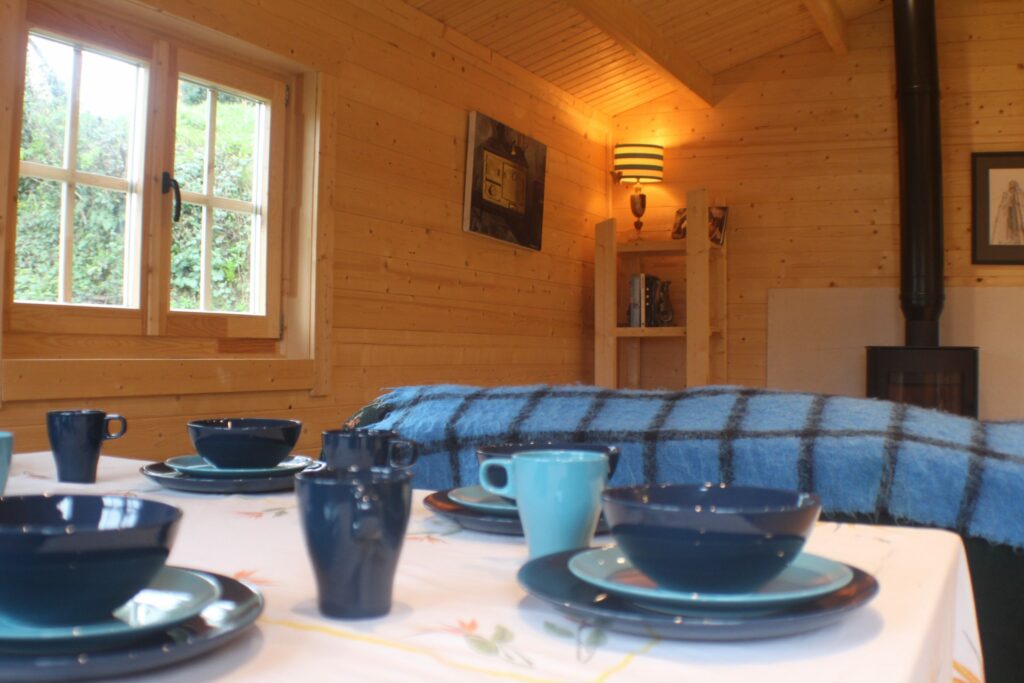
Cosy cabin interior

We have had a lot of visitors to our log cabin show house in Boyle since it was built back in February 2018. For most people, it is their first visit to a log cabin showroom, and they are generally very pleasantly surprised by what they see.

The way our log cabin is tucked away at the back of the garden means that it looks quite small. So our visitors are generally very surprised when they realise that the showroom is a two-bedroom showhouse, with an area of forty-nine square metres (49 sq.m), or five hundred and thirty-three square feet (533 sq.ft).

Timber Living Log Cabins Ireland has been selling log cabins to Leinster and the east of the country for over twenty years, and was delighted to open a show house in the west of Ireland, to service Galway, Sligo, Mayo, Roscommon, Leitrim, Donegal, Cavan, Monaghan and Westmeath.

Cosy cabin interior

What is a log cabin show house interior like?

The reaction of most people has been extremely positive. As soon as you walk into our  log cabin show house, there is something special going on, but it is often hard to put your finger on what exactly that is.  Of course, we in Ireland are not used to a full interior timber surface in our living areas, so seeing all of that timber is both appealing and surprising. Not everybody likes it actually, but most people are really delighted with their first impression.

And of course, if you do not like the wood finish, it is easy to paint all of the walls. In fact, even if you like the timber finish, it would make sense to put some protective varnish coating on your wall, for ease of cleaning, if nothing else.

But actually the real first impression is not as obvious. Because our timber living log cabin show house walls are the highest available in the country, that means that our roofs are also very high. So, when you walk into to any of our cabins, the first sensation, which is usually sub-conscious, is a feeling of openness, because the roof is raised so high.

Painted walls or timber finish?

Unfinished log cabin interior

The biggest debate of all amongst our visitors has been whether or not to leave the full timber finish throughout the cabin. It’s nearly a Brexit debate! A lot of people love the timber finish everywhere, while others really like a painted finish. Of course, there’s always the option to tile, varnish or stain the wood too. It’s always a great debate amongst our visitors, and with couples,  as long as they both see things the same way, there’s usually no problem.

Creaky floors?

Another regular comment from visitors is how solid the floor feels in our log cabin show house.  Some people expect the floor to be creaky because it is a timber cabin. Others are surprised at how solid the floor feels because they have visited other show houses and and a lot of them just don’t feel as solid as a TimberLiving show house.

If you’re cabin is built well, and your foundations are good, there is no reason why you should have a creaky floor. Of course, there will be some movement in the floor due to temperature and moisture changes. If you wish you can put a floor covering down –  carpet, lino or engineered wood.

What is the best log cabin foundation?

A major mistake that some other log cabin companies are making is offering timber frame and block foundations. In our opinion, if you want your log cabin to last a lifetime, you need to have an extremely solid foundation. We always recommend a five-inch concrete slab for our foundations. Any other form of base has the potential for settling, and settling of a foundation is not a good thing or a log cabin.

With the extra-long timbers that are used in log cabins, you can imagine the problems that might arise if one corner of that cabin settles more than the other. This is the sort of thing that happens ith block foundations. You need one complete slab, so that if there is any settlement, it affects all of the cabin equally.

Solid doors and windows

Another good indication of a quality build that how well the windows and doors close. after nearly 2 years as you should expect, windows and doors ( interior and exterior) are performing as well as they did on the first day.

Overnighting in a log cabin

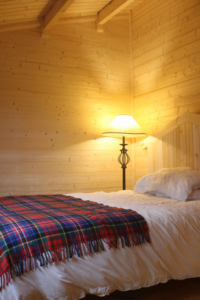
Cosy log cabin bed

We’ve had a few people stay in our show house over the last couple of years: friends from England, Sweden and Germany, family home from the States, Granny and Grandad –  lots of different visitors. And everyone wakes up very well rested. They always remark at how quiet it is – especially those who come from living in cities. And those who stay when its raining love the sound of the the rain on the roof – the cabin really brings people back to mature.

Our cabin is a delightful little haven – quiet, cosy and warm, and well worth a visit.

Where is my nearest log cabin show house?

We have log cabin show houses in Boyle, Co Roscommon, Tullow, Co Carlow and Carrigaline, Co Cork. You can get all the contact information, directions etc from our log cabin show house contact page. Start planning you visit now. And please, ring for an appointment if you’re coming to Boyle – 086 817 0429

See you soon!

Posted on 1 Comment

7 reasons to get your log cabin from Timber Living

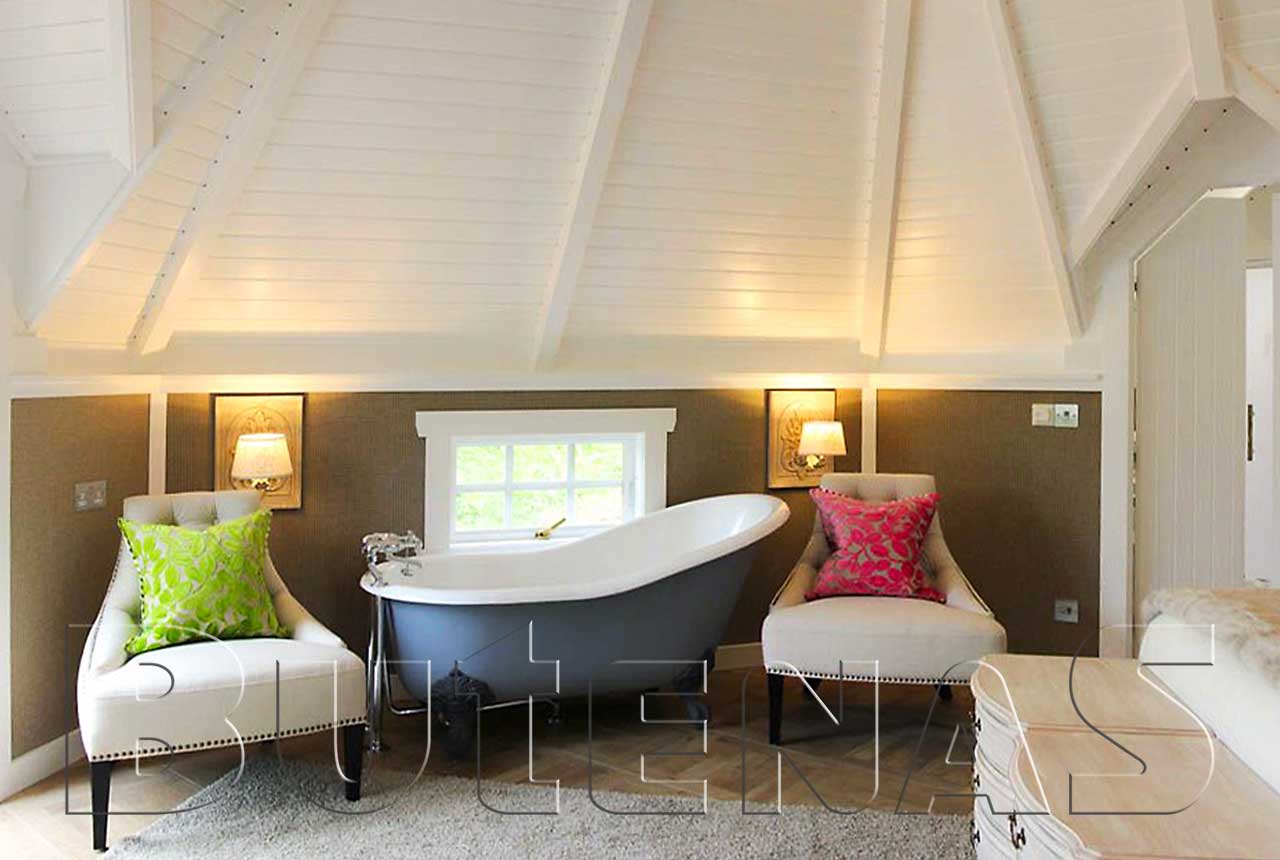
a room with a tub and chairs

Log Cabins Ireland – Over 20 years in the business

We’ve been in the log cabin business for over twenty years, and we’ve come across AND SOLVED every possible problem that might arise with Log Cabins Ireland. That’s why our cabins are designed specifically for the Irish climate, with weatherboards, separate double-leaf construction, excellent levels of floor, wall and roof insulation, and other details.

Log Cabin Kitchen
Our Log Cabin has everything

Who sells the best log cabin homes in Ireland?

Of course, we’re going to say that we sell the best log cabins in Ireland.  Well, what with being in the log cabin business for over two decades, we have had lots of time to find the best log cabin suppliers in Europe – and by best, we mean the highest quality log cabins, at a fair price. We have looked at over 25 suppliers throughout our time in the business, and we are confident that nobody could find better quality, better value log cabins throughout the continent of Europe.

10-year guarantee on all log cabins

We’re quite happy to offer a ten-year guarantee on our buildings. That’s because we closely monitor the production and installation of every log cabin. We stand over the quality of the product, and the workmanship that goes into the production and construction.

Our log cabins last a lifetime

As long as you treat a log cabin correctly, there is no reason why it will not last a lifetime. The high-quality, kiln-dried Norway Spruce timber from Siberia (many of the trees are 150 years old) that we use is as good as it gets when it comes to timber for construction. You can read all about the timber we use in our blog post here: What timber should a log cabin be built with

How to paint your log cabin

Maintenance of your log cabin is key if you want it to last a lifetime. The final element to maintaining your log cabin is treating the walls correctly. All you have to do is treat the walls with SIKKENS, or some other suitable stain (NOT PAINT!) and your cabin will last a lifetime. A stain allows the timber walls to breathe – in other words, moisture is not trapped beneath the impermeable paint skin. This ensures the longevity of your log cabin walls. Read more about not painting your log cabin here.

log cabin w

Double wall construction

If you’re going to stay in your log cabin, it needs to be insulated. Some companies offer 75mm solid walls, with no insulation. This is a disaster in the damp Irish climate. Do not buy a cabin with this spec! You’ll have black mould growing behind your wardrobes and presses in no time. Very unhealthy!

The great thing about TimberLiving is that no matter where you are in Ireland, there’s a showhouse two hours away. Whether you come to see us in Cork (Carrigaline), Carlow (Tullow) or Roscommon (Boyle). Well worth the trip! You’ll be able to come into our show houses and experience firsthand the quality, comfort and style of our best-quality log cabin buildings.

High-quality windows and doorsImage 1 1

You won’t find better double-glazed, tilt-and-turn windows or doors from any other Log Cabins Ireland company. And we offer a range of choices when it comes to windows and doors. Have a read of our blog on window choice for your log cabin here: https://timberliving.ie/post/which-windows-for-your-log-cabin

The insulation you choose is very important for your log cabin. You want the cabin to be warm and easy to heat. That’s why we put a minimum of 100mm of insulation in our walls and roofs. And in the floor, we ALWAYS use PIR (Kingspan) insulation. If a company is putting rock wool in the floor, walk away! Read more about log cabin insulation here; https://timberliving.ie/post/how-well-are-log-cabins-insulated

Posted on Leave a comment

How warm are log cabins during a winter?

It’s the cosiness, the warmth and comfort, that is the enduring image of a log cabin. But the big question is, how true is the image? Are they really that warm and comfortable? And how much does it cost to keep them warm?

Cozy, comfortable log cabins

Are log cabins warm?

Log cabins can be wonderfully arm and cozy, and reasonably cheap to heat. It is all about how the log cabin is constructed.

Like any building, the insulating value of the walls, roof and floors decide how warm the building will be, and how easy it is to heat. Think about it – if you’re lying in bed on a cold winter’s morning with only a sheet covering you, you’re going to be cold no matter what the sheet is made of.


So, in your log cabin, you need a wall thickness of more than 6 inches (150 millimetres) if you want a log cabin that is warm and coy in the winter months.


Some companies offer log cabins with only a 3 inch (75 millimetre) thick timber wall, and if you by one of these, you’re going to have a cold, cold log cabin. Brrrrr! (You will also have a damp log cabin, with black spots on the walls and quite possibly water coming through. So don’t buy a cabin with 3 inch thick walls.)

What are the best log cabin walls

Are log cabins easy to heat?

At Timberliving, we  offer double Leaf walls. Our standard build is a 45mm outside wall with 100mm cavity and a 30mm inside wall. This gives you plenty of insulation, as well as a very strong internal wall from which you can hang kitchen presses and anything else of significant weight.


Do log cabins need to be insulated?

You could easily argue that you do not need to have insulation in your log cabin walls, but that would be true only if your log cabin walls are solid wood and a minimum of 8 inches (200 millimetres) thickness. But this class of a log home is very expensive to buy and build.


If you’re planning on using your log cabin for sleeping in, especially during the winter, you will need to insulate your walls. We build our cabins with a standard four inch (100 millimetre) cavity, and use a product called METAC, which is a high grade, quality thermal insulation, as insulation within the cavity.

And the wall insulation does more than just help keep the heat in. Wall insulation also ensures that there is no mould within the cabin itself. If your cabin is built without wall insulation, and is being regularly heated on very cold winter nights, you can expect mould, in certain situations. Mould is generated when moist, warm air touches cold surfaces and condenses. Take a situation in a single wall, uninsulated cabin, with (say) outside temperatures of 2 degrees, and a stove heating the cabin inside. The surfaces of the walls will be warm, EXCEPT behind wardrobes and presses, because it will be difficult for the warmth to get behind these fittings. So, you will have damp air connecting with these cold surfaces. The dampness in this air condenses on the cold surfaces, encouraging the growth of mould. NOT a pretty picture…

Increasing your log cabin insulation levels

If you are going for planning, you will need greater insulation in the walls and roof of your cabin. Wall insulation thickness can be increased either by increasing the size of the cavity, or using external insulation full stop this has the benefit, from a planning point of view, you of having a cement board finish, which is often a requirement of planning applications.

Log cabin wall thickness and noise proofing

One of the benefits of our double Leaf walls is the noise insulation they provide.  Come to one of our showrooms and here for yourself how quiet it is inside a timber living log cabin. Whether you are looking for a residential log cabin , a granny flat one bedroom log cabin, or if you have your own bespoke design log cabin we can provide you with the insulation levels you require.

Are log cabins easy to heat?

Of course, if you have a well insulated log cabin, there will be a smaller heat requirement. And the smaller the heat requirement, the easier, and CHEAPER! it will be to heat. And that means a number of benefits to you, the user. The ongoing savings made with less fuel buying is great, but it also means that the hardware you buy will be cheaper too. A smaller stove, for instance, is going to cost a lot less than a stove twice its size. You can expect a few hundred euro on your hardware cost if your cabin is well insulated. And then there’s the fuel handling, especially if you’re using a solid fuel stove or boiler. That means carrying is and less ashing out too!


What heating system can I use in my log cabin

You can use any form of heating system in your log cabin: solid fuel, wood pellet, back boiler with rads, oil or gas, or even heat pumps and/or underfloor heating. Whatever heating system you use, your heating requirement and bills will be very much reduced as you increase your insulation. We have a blog post about heating your log cabin – take a read here: Heating a Log Cabin

Why not come and visit us at our showrooms in Boyle (086 817 0429), Tullow (05991 81039) or Carrigaline (087 6464 280) and see for yourself the quality of our log cabins.

Posted on Leave a comment

The benefits of timber in log cabin construction

Log Cabin Construction - interior showing floor and wall insulation

We build a lot of block houses in Ireland. I would say over 90% of all of the people who read this post have lived over 90% of their ives in block or concrete homes. People in Ireland are not familiar with building in timber; we see log homes as exotic dwellings from Scandanavia or Canada or Wyoming. But log cabins are definitely ideal for Ireland’s temperate climate, and there are many benefits to be gained from log cabin living.

How Long Do Log Cabins Last?

“How long will my log cabin last?” is probably THE most common question we are asked by visitors to our log house showrooms. Because nearly all of us were brought up in block or stone houses, It is only natural that we have doubts about quality log cabin timber. But we know that, when we were growing up, every door in the country was made of timber. And they make boats out of timber too! So as long as timber is minded well and treated properly, your log cabin home will last a lifetime.

People think that, due to damp Irish weather, that a log cabin might not last as long here as it would in other, colder countries. But that s a misconception. The damp weather is not detrimental to timber, as long as it is managed. By that I mean that the external coating of the log cabin – what stain you use – is ultimately the most important element in maintaining the longevitiy of your log cabin. Make sure you use the right stain (we recommend Sikkens, from Dulux – read our blog post here: How to Paint Your Log Cabin) And if you need more reassurance regarding log cabins and Irish weather, well, we live in the windiest country in Europe (did you know that!). And that constant wind is the perfect way to keep your log cabin walls dry in damp weather. Take a trip to the Boyle showhouse in a wet and windy day and you can see for yourself how well our log cabins can withstand the ravages of Irish weather. Its really not a problem to them – I would say that the extremes of Scandanavian or CAnadian winters is a lot more detrimental to log cabins.

Some benefits of Timber in buildings

file 5

Log cabins have a very low carbon footprint

Because we do not use steel or concrete in construction of log cabins, the carbon footprint of the building is very low. An enormous amount of energy goes into creating concrete and steel, and of course in the generation of this energy, huge amounts of carbon are emitted. So, keep it clean and keep it green, and build a log cabin :-)

The timber for all of our log cabins comes from sustainable Russian forests. In fact, Russia has been growing forests sustainably for centuries – replanting trees for every tree that has been felled. It is a law that has been in effect for over a hndred years, and of course, it makes gret sense. Russia is one of the World’s main timber exporters because of its great forestry industry.

A2 BER for log cabins

Your log cabin can have an excellent BER (Building Energy Rating). As long as a building is sufficiently well insulated and air sealed, and with the correct renewable energy system (in line with the new building energy ratings regulations) there is no reason why you cannot get the BER or you want for your log cabin.

Healthy timber home environment

Because there are no chemicals, additives, plastics or formaldahyde used in the timber of our interior walls, and no dust generated through the use of plasterboard, the environment in a Timber Living log cabin home is ideal for anyone looking for the healthiest home environment. And since our buildings are breathable, there is no condensation, giving further benefits and a better home environment.

Environmentally friendly building waste from your log cabin

file 1 1

When we complete the building of a log cabin, there is very little waste. Normally, there is a lot of timber left over, because we always send more timber than we need to a site in case of problems. As our client, if you are interested in keeping the excess timber, we are glad to leave it with you. This timber can be used to for firewood or to build furniture. (All the beds in the Boyle showhouse are made from excess timber. I also made two cat houses and a hen house, and I still have wood left over!)

Also, with block building, one of the main headaches for planners and builders is where to deposit the environmental waste from block building – leftover steel and concrete, plastics etc. With our log cabins, the only real waste we have to deal with is the plastic wrapping which we use to cover the timber during transport. And that plastic is very recyclable – we have a very straightforward, quality assured method for disposing f all of our environmental waste.

Log cabin wall insulation

By default, all of our log cabin walls have a 100 millimetre (four inch) cavity.

file 2 1

Overall, our walls are over even inches thick – the 100mm (four inch) cavity is made up of an external wall of 45mm (nearly two inches) and an internal wall of 30 millimetres (about an inch and a half). (This cavity size can be increased if you wish.) But the key point is that your wall is doubly insulated – firstly by the insulation itself, but, as we all know, timber is also a good insulator – so the walls re insulating, unlike plaster walls, which draw heat out of a room.

Posted on Leave a comment

Financing your log cabin

A log cabin from Timber Living Log Cabins Ireland is a great investment – half the price of building with block – but its still a lot of money. So, what’s the best loan option out there?

Financing your log cabin

How do you finance a log cabin?

The ways things are nowadays, it seems harder and harder to get loans for anything these days, especially when it comes to your residential needs. Which makes you wonder why banks are so picky about lending for log cabins – surely these people – who are so careful with money – should be a lot more eager about log cabins, since they are such good value!


We have many customers coming to us buying log cabins, and there are myriad ways in which they finance their log cabins. If people are lucky enough to have sufficient savings, they may only need a top-up loan, which is usually asy to get. Others manage to borrow from family, with a promise to pay back rent-sized amounts every month for a fixed period of time.


But if you have to go through official channels, what are the options for buying a log cabin?


A Credit Union Loan for your Log Cabin?

Have you thought about a Credit Union Loan for your log cabin? (Read more about Credit Union loans here.)

There’s a notion going about that you have to be a member of a Credit Union before you can get a loan. This is not the case with every Credit Union. Each Credit Union is different, and is run soley for the benefit of its members, rather than for the benefit of its shareholders.

Because each Credit Union is different, they can decide individually who to give loans to, and what to give loans for. Many of our customers have financed their log cabins with Credit Union loans, without a problem

.

Will Your Local C.U. finance your log cabin?

Well, the first thing you need to do is find where your nearest Credit Union is. You can find a full list of Credit Unions here: https://www.creditunion.ie/credit-union-locator/ There are 326 Credit Unions in Ireland, so you’re bound to have one nearby. And there’s nothing to stop you enquiring for a loan from more than one Credit Union.


How to Appy for a Log Cabin Loan

There’s a very simple to use Loan Application systema available on the Credit Union website: https://www.creditunion.ie/enquire-about-a-loan/

Just fill out the form and send off your request – it couldn’t be easier :-)


Can you get a mortgage for a log cabin?

Normally, banks will not offer mortgages for log cabins. There are a few issues, not least the fact that cabins are often not expensive enough to qualify for a mortgage. Its almost as if the banks don’t want to encourage the Log Cabin market, because they wouldn’t make as much money out of it as they are currently making out of the housing market. Could that be the reason?!


How much is it to buy a log cabin?

When purchasing your log cabin from Timber Living Log Cabins Ireland, there are other costs that you will need ot figure in to your financial plan. Let’s consider one of our favourite cabins, the Sutton Two Bed Cabin. There’s the cost of the cabin itself, currently on sale for €28,000, delivered, built and fully insulated, VAT included. On top of that price (assuming you already wn the site) you will need to install a 5 inch concrete base. You will also need to factor in the cost of electrics, plumbing and a heating system. After that there’s all of the fixtures and fittings, sanitary ware, kitchen, and other furnishings. You will need to connect to water and electricity supply, and have somewhere for your grey water and sewerage waste. Finally, I should mention that we don’t supply gutters.


Log Cabin Showrooms

Before buying a log cabin, it man=kes emminent sense to actually go aloong to a showroom and see exactly what you’re thinking of buying. Many, many people who visit the Timber Living Log cabin Showrooms here in Boyle are first time visitors to log cabins. It is always quite a revalation to people when they come to a log cabin for the first time.


Timber Living Log cabin Showroom, serving Galway, Mayo, Roscommon, Sligo, Donegal

People are initially surprised by the size of the Boyle Log Cabin Showroom interior. They are always very pleased with the soothing atmosphere which the wooden interior walls give – I think there is a bit of sound muffling due to the timber surfaces – one of those things you don’t really notice, but which is different to what people are used to…

I had one visitor, Johnny, who had already visited a couple of log cabin companies. He spent the first five minutes of his visit not saying much, but just walking through the different rooms of the show house, and walking heavily in different spots. Finally he said “I’m trying to find squeaks in your floor. How come your floor doesn’t squeak, when the other showhouses do?”


What is the best log cabin near me?

Well, Johnny had found the best log cabin company (us!) but we were not the nearest to him. Anyway, he felt it was worth a trip to us here in Boyle, because he wanted floors that didn’t squeak!

We have showhouses in Boyle, Co Roscommon, Tullow, Co Carlow, and Carrigaline, Co Cork. So I imagine we’re within a couple of hours of you. Come and visit us, and you can see for yourself what I am talking about.

Posted on Leave a comment

Log cabin maintenance – what’s best for your log cabin

When people think of log cabins Ireland, and living in a timber home, one of the most important questions they ask is about log cabin maintenance and how easy it is to maintain the exterior of your log cabin home.

Staining (not painting) your log cabin

Is it hard to maintain a log home?

Of course, this is a valid concern. Particularly considering the fact that most people are not familiar with maintaining timber homes in Ireland. But we must remember that there are thousands and thousands of timber homes being lived in all across Europe, the United States and many other parts of the world. And methods of log cabin maintenance have been developed over the centuries to make sure that log cabins can stand up to all of the vagaries that the weather can throw at them.

Are Log Homes High Maintenance?

You would think that with all of the modern conveniences that technology has benefitted us with in the last few decades – dishwashers, washing machines, hoovers, smartphones and the rest – that life would be a bit easier, and we would all have lots of free time to do the things that matter. But no! It seems that nowadays, we have less time than we ever had to do the important things in life. Anyway – back to the question.

Are Log cabins easy to maintain?

The truth is that the maintenance of a log cabin is very, very straightforward. People are concerned about the durability of timber, but we like to remind them that they make boats out of timber. Every hall door in the country was made out of timber, before the advent of PVC and aluminium windows and doors, and they lasted forever, as long as they were well maintained. Timber is a fantastically durable material, as long as it is well maintained. Have a read of our blog post about the quality of wood we use in our log cabins. What timber should a log cabin be built with?

So how do we maintain our log cabin home?

The most important thing to remember is not to use paint! Paint forms an impervious skin on the surface of your wood and seals it so that any moisture within the wood cannot get out. This is not a good thing, and that is why we recommend that you use a stain on the external surface of your log cabin. The correct stain will allow the timber of your external walls to breathe, but will also prevent the rainwater from penetrating the surface of the wood. If yu come along to the Boyle Log Cabin showhouse, you can see (on a rainy day) how water runs down off the sruface of the cabin walls. We have three coats of stain on the external walls, and it looks great from even a short distance. But if you look closely, you can see the timber beneath the coating.


What should I treat my log cabin with?

What we recommend is to use a material called Sikkens.  Sikkens is a Dutchproduct, and it has been highly recommended to us by a number of professionals in the business, not least a colleague who is a professional in the business and based in The Netherlands. We have a very detailed blog post all about the exterior treatment of your log cabin, which I suggest you read. Once your log cabin is built, you need to apply preservative to the timber and then 3 coats of Sikkens. After this initial task,  there is no need to treat the exterior of your log cabin for another 3 or 4 years.

Sikkens for Log Cabin exteriors

How much does log cabin maintenance cost?

Sikkens is a highly rated product throughout Europe, and on the continent, it is more expensive than standard paint. Fortunately for us in Ireland, though, a tin of Sikkens stain is about half the price of the equivalent item on the continent! What is that? I cannot be sure, but I imagine it is because there is so much more timber on the continent to be treated, so people, in general, know a lot more than we do in Ireland about treating timber buildings, and they are experts in knowing what product works well. And when you know a product is the right one for your log cabin, you are happy to pay more for it.


It is also important to keep an eye on the clear mastic seal around your doors and windows and make sure to repair this if there is any break in the material. It is a quick job and easily done. A stitch in time saves nine, as Granny used to say.


The only other major maintenance task but you need to perform is a very light one. It is very important that there is no way that moisture can get into your log cabin walls. The only way this can happen is if you allow earth or other materials to lie against the cabin walls. Anything that enables moisture to gather and seep into the walls will cause you problems. As long as you can keep your walls clear, everything is going to be ok.


Your log cabin is raised off the ground for this very reason. We have been asked now and again if we would build a cabin in an existing yard, and e always insist that a two-inch high pad be built, upon which we would build the cabin. This is in order to ensure that the cabin never ends up sitting in a pool of rainwater on the yard surface. Something like that would be very detrimental to the cabin.

Why is proper Log Cabin Maintenance important?

Here are a few pictures of a log cabin that was not treated properly.

Poor log cabin maintenance
You need to paint your log cabin

Log cabin exteriors need proper treatment
Badly treated log cabin

b2a383eb bf0d 4b4e 9076 af4bbc6446c1

These images illustrate how important it is to treat your log cabin exterior well. There are plenty of examples of old cabins that are in great nick. All of these have had regular log cabin maintenance carried out.

If you have any questions in relation to log cabin maintenance, or if you would like to visit us in one of our showrooms, please contact TimberLiving Log Cabins now.

Tullow, Co Carlow (05991 81 039)

Boyle, Co Roscommon (086 817 0429)

Carrigaline, Co Cork. (087 6464 280)

Posted on Leave a comment

Living in a log cabin home

There are many fans of log cabins in Ireland. I think we all know some people who might never have a chance to actually live in a log cabin, but they still cannot stop themselves from googling log cbins, following timberliving on facebook, and forever dreaming that dream. And who can blame them?!

Log cabins are very different from your standard house, but the atmosphere within a log house is so comfortable, warm and inviting. The complete timber structure appeals to us all on a very base level, I believe. Its all part of our yearning to go back to nature, among the trees and forests of our forebears. And there’s also the rigidity, strength and warmth that the timber walls exude – you get a completely different sense from timber walls to the sense you get from cold plastered concrete walls – there’s no doubt about it.


Visit our Log Cabin Showrooms and See for Yourself

When you enter a timber living log cabin, the first impression you get lasts. Whwen people come to visit our show houses, they always take a moment when they first enter our cabins. There’s an intake of breath, usually followed by “Wow, I didn’t expect it to be so big” or “This is lovely”. Other people say nothing, but just take a few moments to take in that first impression, and enjoy the feeling.


Cosy, Warm, Inviting Interiors

Because of our high walls (you won’t find a cabin in Ireland with higher walls than ours), our roofs are higher. These higher roofs give a lovely sense of space that you just wouldn’t get with a standard flat ceiling. Coupled with the bulky rafters, there’s a real sense of old-world strength and durability – what a reassuring first impression to get from a home!

Living in a log cabin home – what does it look like?

Our Log cabins are cosy as can be, because of the high quality insulation in all of our timber homes. We use PIR insulation in our floors, which is something a lot of our competitors don’t do. They use cheaper mineral wool (presumably because its cheaper, but also because their lack of experience means they are not aware of the issues that WILL arise if you put mineral wool insulation in a log cabin floor. Damp winter air condenses on the surface of the concrete floor slab, and this condensation is soaked up by the mineral wool, turning the insulation into a soaked sponge. This makes the floor comld AND damp – which means a string of disasters for the future of that cabin…)

You can read about the quality of our log cabin insulation in our blog here.


Can I install a stove in a log cabin?

A beautiful stove gives off perfect heat within a log cabin, and it is very straightforward installing a stove in your cabin. We have a blog post on stoves for log cabins here: Can I install a stove in a log cabin?

Of course there are many different options for log cabin heating:  you can put in radiators, and these came be run off a stand-alone boiler (oil/gas) or a back boiler off your stove (gas/wood/turf/coal). If you want, you can put in underfloor heating,air to air heat pumps, whatever. There’s no reason why you cannot put the same heating system into a log cabin as you can put into any type of house.

Is a log cabin cheaper to build?

And the most important thing about our cabins is the cost. You get a high quality timber home from us for half the price of a conventional build. Our windows and doors are of superior quality double glazed, with tilt and turn options, with high grade hardware all round. You can also upgrade to PVC white or coloured windows for less maintenance, if you wish. And your log cabin will be built in weeks rather tahan months or years. (Order now, and you could be moving in to your new cabin in three months!) Because most of the work in creating the cabin is done by high tech precision machines at the factory, our labour costs are very much reduced, and of course, this reduction is passed on to the customer.

Sometimes people think that a log cabin is built too quickly, but the truth is that block built buildings are really built too slowly! And you could not come up with a less efficient way of building. Some guy standing in the rain, putting one blovk on top of another for WEEKS on end! Or make the stuff up in a warm, dry factory with a machine, and just put it together on site – which one makes more sense to you?!


Are log cabins environmentally friendly?

Your new home will also be eco-friendly with a minuscule carbon footprint compared to a block build. In these days, that is not a bad thing at all.

The amount of energy used in creating the concrete and steel used in a conventional build is huge. That is why it is laughable that the government insists on everyone having an A2 BER, but does not insist on all homes being built with timber and banning concrete in anything but the foundations of a house.

Remember too that a timber home, with insulating timber walls means that your heating costs throughout the year will be reduced. Another bonus!

Cosy, comfortable Log Cabins

Are you thinking about a  residential log cabin for long-term living? Maybe you have a bespoke log cabin design in mind for your house? Whether you are looking for or one bed log cabin, two bed or 3 bed log cabins we have a wide range of designs that at one of which is bound to be perfect for you you.

If you have never been inside a log cabin, you should contact Timber Living at our showrooms. We have showrooms in Tullow, County Carlow, (05991 81039), Carrigaline County Cork (087 64 64 280)   and Boyle County Roscommon, (086 817 0429). Why not contact us straightaway and make an appointment?

Posted on Leave a comment

How Long Does a Log Cabin Last?

Best Log Cabins Ireland has seen

How Long Does a Log Cabin Last?

People often ask “How long do Timber Living log cabins last?” It’s a reasonable question – we’re not overly familiar with log house living in Ireland, so the use of timber on the exterior of a building is something that concerns people. But we like to remind people when asked this question, that a). they make boats out of wood b). every front door in the country was made out of wood, before the advent of PVC

So, the answer to the question is – Log Cabins Last a Lifetime!

How to Maintain a Log Cabin

Of course, if you want your log cabin to last a lifetime, you have to maintain it well. Water is timber’s enemy, and as long as you can protect your log cabin from the damage that water can do, you will have a log cabin that will last for many. many years.

The first step in keeping your log cabin dry is by building it on a base that is raised up from the ground above it, and that is ten millimetres all-round shorted than the cabin itself. Doing this means that the cabin overhangs the base by ten millimetres on every edge. We also include a throated rain sill all around the base of our log cabins. These two measures ensure that there is no chance of water pooling underneath the log cabin. If your cabin was standing in a pool of water, the water would be soaked up by the cabin timbers, and that would lead to rotting. So, the secret is to keep underneath your cabin bone dry. Here’s a video that goes into this in more detail.

Quality Timber – that’s the secret!

We’re not familiar with Log Cabins in Ireland, but that is no reason not to consider TimberLiving’s residential log cabins as an excellent option for your new home. What is a house anyway, but four walls, a roof and a floor? As long as the right timber is used, your log cabin will last for many decades. All of our timber is sourced from sustainable forests within the Arctic Circle. We use the finest, slow-growing Norway Spruce, which is a time-tested, and well-proven timber used in the construction of log cabins throughout Europe for centuries.

Have a read of our blog post What Timber Should a Log Cabin Be Built With.

What is the lifetime of a log cabin?

The right timber is of course, a very important element of your log cabin, but you also need all of the other elements – windows, doors and roof cover – to be of the highest quality in order to extend and maintain the lifetime of your log cabin. And we use only the best of elements in our log cabins, built to the highest EU standards. Here is a blog that tells you all about the tilt and turn, double glazed windows and window choices we offer in our cabins: https://timberliving.ie/post/which-windows-for-your-log-cabin

Our roof cover is a pressed steel, tile effect, and profiled roof cover. This is finished in a hard-wearing paint, so there will be no corrosion on the roof. It is also highly effective from a wind point of view. We have never had any of our roofs suffer from wind damage. And we have a cabin built on the Aran Islands, so we can speak with confidence about the reliability of our roofs!

Because our roofs are at such a shallow angle, it is not a good idea to fit tiles on the roof. It is recommended that your roof be at a slant of greater than thirty degrees if you want individual tiles fitted to your cabin roof. This is because wind can get under smaller tiles on shallow roofs and lift them, and also because stronger winds can actually drive rain in under individual roof tiles on shallow roofs.

What kind of paint do you use on a log cabin?

What log cabin paint should you use? Well, you don’t use paint on your log cabin! You should actually use a stain, such as SIKKENS, rather than paint. Stains let the timber breathe, so moisture is not trapped under the exterior coating. And there’s a wide range of colours available from SIKKENS. We have a few posts about treating log cabin timber.

Log Cabin exteriors require treatment every three or four years. Once they are well-maintained on the outside and kept dry (that’s the secret) your Timber Living log cabin will last for a minimum of 60 years. Make sure there is no soil up against any of the timber, and that there is no opportunity for water to pool under your log home, and then there will be no fear of trouble with your log house. These rules apply, whether you’re building a one-bed cabin granny flat, a two-bed log cabin or three-bed log cabin, or your own, bespoke log cabin.

Please don’t hesitate to call us at our showhouses in Tullow (059 918 1039), Carrigaline (087 6464280) and Boyle (086 817 0429) with questions, or to make an appointment.