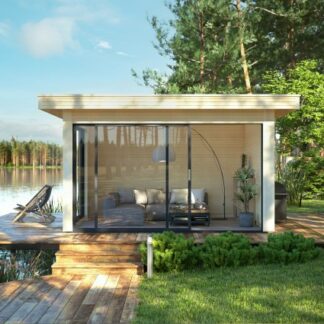
“Do You Need Planning Permission for a Log Cabin in Ireland?”
It’s the first question almost everyone asks.
Before price.
Before design.
Before layout.
And for good reason.
Because no matter how beautiful the cabin is — if you can’t get planning permission, the dream stops there.
Right now, one of the most searched terms in Ireland is:
- “Planning permission for log cabins Ireland”
- “Do you need planning permission for a log cabin?”
- “Residential log cabins planning rules”
That tells us something important.
People aren’t browsing.
They’re serious.
So let’s answer it properly.
The Short Answer
✅ If it’s for residential use — YES, you need planning permission.
✅ If it’s a garden room under 25m² and not used for sleeping — you may be exempt.
But the real answer is more detailed.
And this is where many websites oversimplify things.
What the Irish Planning System Actually Looks At
When applying for planning permission for a log cabin in Ireland, the council doesn’t ask:
“Is it timber or block?”
They ask:
- Is it habitable?
- Is it compliant?
- Is it suitable for the site?
- Does the applicant meet local need (in rural areas)?
Your building material is rarely the deciding factor.
It’s about use and impact.
Residential Log Cabin vs Garden Cabin: The Critical Difference
Garden Cabin (Possible Exemption)
You do not need planning permission if:
- The structure is under 25m²
- It is located behind the front building line
- It does not exceed height restrictions
This is typically for:
- Home offices
- Gyms
- Hobby rooms
- Storage
But the moment you add:
- A bedroom
- A bathroom
- Cooking facilities
- Full-time occupation
It becomes residential.
And that changes everything.
Planning Permission for Residential Log Cabins in Ireland
If you plan to live in the cabin full-time, it is treated the same as a traditional house under Irish planning law.
You will need:
- Full planning application
- Site maps
- Architectural drawings
- Site suitability assessment
- Percolation test (if using septic tank)
- Compliance with building regulations
The council assesses it exactly as they would a block-built home.
Because legally — it is a home.
Rural vs Urban: Why Location Matters
Planning outcomes depend heavily on location.
In Rural Areas
You may need to demonstrate:
- Local housing need
- Connection to the area
- Compliance with county development plan
- Appropriate site access
Some counties require proof that:
- You grew up locally
- You have family land
- You work within a certain radius
This is not specific to log cabins.
It applies to all one-off rural housing.
In Urban Areas
Planning is assessed based on:
- Zoning
- Density
- Impact on neighbours
- Design compatibility
In towns and cities, local need is usually not a requirement — but space restrictions are tighter.
Why So Many People Get Confused
There’s a lot of misinformation online.
You’ll hear things like:
- “It’s timber, so you don’t need planning.”
- “If it’s removable, it’s temporary.”
- “If it’s under a certain size, it’s exempt.”
These statements are incomplete.
In Ireland, planning is about use — not whether it sits on wheels or timber posts.
If it is being used as a dwelling, it requires permission.
Simple.
Can You Get Refused?
Yes.
Just like any house application.
Common reasons include:
- Inadequate sight lines for access
- Failing percolation tests
- Overdevelopment
- Not meeting local need criteria
- Poor design integration
But refusal rates are often linked to poor preparation — not the building type.
That’s why professional drawings and proper site assessment matter.
Does a Log Cabin Meet Irish Building Regulations?
This is another major concern behind planning –
A properly constructed residential timber home must comply with:
- Structural stability (Part A)
- Fire safety (Part B)
- Moisture resistance (Part C)
- Sound (Part E)
- Ventilation (Part F)
- Conservation of fuel and energy (Part L)
Modern timber frame construction can meet — and often exceed — these requirements.
But only when built to residential specification.
Cheap imported garden cabins will not meet these standards.
That distinction is critical.
How Long Does Planning Take?
Typical timeline:
- Application submitted
- 5-week public notice period
- 8-week council decision window
- 4-week appeal period
Realistically, from submission to final grant: 3–4 months (if smooth).
Appeals can extend that timeline.
What Increases Your Chances of Approval?
If you want the strongest possible application:
✔️ Work with professionals familiar with your county
✔️ Ensure sight lines meet road safety standards
✔️ Complete a proper site suitability test
✔️ Design the home to blend with surroundings
✔️ Address local housing policy early
The smoother your preparation, the smoother the process.
Are Timber Homes Harder to Get Approved?
No.
Planning authorities assess:
- Size
- Scale
- Impact
- Use
Not whether the walls are timber or block.
In fact, sustainable construction is increasingly viewed positively.
Timber has strong environmental credentials, which aligns with national climate objectives.
What About Temporary Permission?
Some buyers ask about temporary planning permission.
In Ireland, temporary permissions are rare for residential dwellings unless:
- There are specific site circumstances
- Agricultural needs apply
- Replacement homes are involved
You should plan for permanent approval.
The Real Question Behind Planning Searches
When someone types:
“Do you need planning permission for a log cabin in Ireland?”
What they’re really asking is:
“Is this realistic for me?”
And the honest answer is:
Yes — if you approach it correctly.
Thousands of timber homes exist across Ireland.
They are not loopholes.
They are legitimate housing solutions.
Step-by-Step: Your Planning Journey
Step 1: Site Assessment
Check zoning, access, and services.
Step 2: Engage an Architect or Engineer
Prepare compliant drawings.
Step 3: Complete Site Suitability Testing
Percolation and drainage.
Step 4: Submit Planning Application
Include notices and documentation.
Step 5: Await Decision
Respond promptly if further information is requested.
Step 6: Build with Confidence
Final Truth: Planning Isn’t the Obstacle — Uncertainty Is
Most people delay their decision because they fear rejection.
But the Irish planning system is not anti-timber.
It is pro-compliance.
When your application:
- Meets regulations
- Respects the development plan
- Addresses site conditions
You stand every chance.
Thinking About Applying?
If you’re currently researching planning permission for a log cabin in Ireland, you’re not alone.
More people are actively moving from idea to action.
The next step isn’t guessing.
It’s getting real advice based on your site.
Visit a Timber Living Showroom
Walk through a completed residential model.
Ask about insulation, compliance, planning preparation.
📍 Tullow, Co. Carlow
+353 59 918 1039
+353 86 821 4537
📍 Boyle, Co. Roscommon
+353 86 817 0429
📍 Carrigaline, Co. Cork
+353 87 646 4280
Or explore residential models online and start the planning journey properly.
Because the question isn’t:
“Do you need planning permission?”
The real question is:
“Are you ready to build?”